Bloggings of the pastor of First Congregational Church, Brimfield, Massachusetts.
You are a vessel designed to hold God's blessings. God wants to fill you to the brim...and then some!
Salt and light were essentials of life in the ancient world. True salt was so important; it was often used as currency. Salt was a matter of life or death, the only way to preserve food in the intense heat. And the oil in the temple that fueled the ever-burning flame was a sign of the assurance of God’s love and protection. When Jesus tells the disciples that they are salt and light, he is reflecting back to them their true value as children of God.
God, help us to recognize our value to each other as we bravely and humbly shine our light wherever we are today.
Jesus is moved to action through mercy. This and other healing stories show Jesus' concern not to draw attention to himself or even his ministry. In this case he compassionately responds to a plea from someone who is an outcast because of his illness. The man with a skin disease is unable to participate fully in society. He is not permitted to worship at the temple and fear of contagion keeps others away from him. While these details don't pertain to our situation today, we surely have too many people separated from full participation in society because of stigmas of all sorts. As followers of Jesus we need to show mercy and remove those stigmas so that all may fully participate in society. Surely we have the power since we are the ones who created them.
What stigmas can you help to remove by simply refusing to continue to support them?
As we enter this season of Lent, we already know how the story ends. It’s the story of the fulfillment of a promise embedded in Hebrew scripture, God’s promise to Israel to send a Messiah, a new king, who would raise up the righteous and usher in the promise of the kingdom of heaven. In this passage we hear echoes of Moses encountering God on the mountaintop as he received the Ten Commandments. The disciples follow Jesus up the mountain where he begins to share with them the promise of God’s blessing on all who hunger after righteousness, all that are pure of heart…peacemakers and prophets.
As we travel to Easter morning, we have the opportunity to examine our hearts as we follow in the footsteps of Jesus. Where will we encounter God on this journey through suffering, death, and resurrection? How are we blessed, filled, and comforted by God’s grace in our daily lives?
God help us to hear your voice calling each of us to do our part in ushering in the kingdom of heaven on earth.
Tuesday, February 21, 2012
Daily meditations can be a beneficial Lenten practice. It is our hope that by focusing on one gospel you will take these forty days to gain a perspective on the life and ministry as presented by Matthew. We recommend that before you begin the daily readings that you take the time to read the entire gospel, preferably in one sitting.
The Gospel of Matthew is structured around groupings of the teachings of Jesus, called the five great discourses. These daily meditations are structured around those discourses. Each day you will find two meditations, each will be posted on the blog, where you may feel free to respond with a comment. The first is written by Mardi on some piece of a teaching story and will be posted at midnight. The second is written by Ian on some story about the actions of Jesus or the disciples that comes from the section following that discourse and will be posted at noon. During Holy Week the focus shifts to scriptural stories about storms. Those six stories will shape the Sunday worship services during Lent.
Feel free to use these meditations as best suit you. You could read them both at the same time. You can use one to begin your day and the other to reflect on it. You could use Mardi's prayer as a repeated grounding throughout the day or you could use Ian's question as a pondering throughout your day. However you use them we hope that they bless you and that you will consider sharing what you discover on this 40-day journey with others along the way.
Former National Geographic photographer, Dewitt Jones, says that his assignments for the magazine always entailed seeing what's right with the world. On assignments to areas where there was suffering he always looked for what was right even in terrible suffering. That perspective helped him to take award-winning photographs showing beauty in many situations. This is not just a shallow attempt to ignore pain, although it certainly can be limited to pretending that all is well when it is not. What I hear in his message is the importance of perspective. Sometimes it is easy to see blessing, sometimes we have to believe that God's blessing is present and dig deeper to find it.
In the Sermon on the Mount, Jesus insists that the most unlikely ones are the ones who are blessed. He tells us that the poor, the humble, and those who mourn are blessed. He even tells us to rejoice when we are persecuted! The word that is translated “blessed” (or sometimes “happy”) might better be translated “privileged by divine favor.” Consider that aspect of blessing; when you suffer, you are privileged because God will be with you in that suffering.
As we move toward the dark specter of holy week, when we remember Jesus' suffering and death, it is good to consider how his willingness to accept his fate brought redemption to the horror of the cross. God is present in the world in the work of the crucifixion. In the extreme ugliness of human behavior God brings the good news that death is not the ultimate victor.
Because of Easter, we can be unashamed hope-mongers. There is no evil so great that God cannot defeat. And when we embrace this truth and make it our own, we can be our best for the world. The good news of Easter is not just about your individual trip to heaven. It is about the hope that there is always something right with the world, regardless of appearances to the contrary. When we are our best for the world, we have something extremely positive to share, the gospel. We have the joy of sharing the good news with others. But there is no good news to share if you don't see what's right in your life and in the world around you. There is no point in walking somewhere to preach if your walking isn't preaching!
So live the good news that death has no sting and the grave is not the victor!
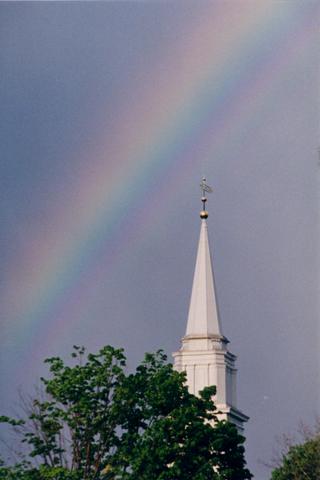
When I was ministering in Salem, I learned a valuable lesson about true diversity. Our inter-faith religious leaders group had the challenge of being truly inter-faith. It wasn't the typical group of Christian clergy making room for the rabbi. The faith communities in Salem included Fundamentalist house churches, B'haiis, and pagans of many stripes. When we gathered in community worship we found that we couldn't just reduce everything down to that which wouldn't offend. It was alright when the Christians met with Jews, we could agree to stick with the Old Testament, but start throwing in groups that don't recognize that as scripture and you start to find less to share. This least common denominator approach proved quickly to be ineffective, since it left us with nothing to use. Instead we decided to welcome each participant to bring something from the richness of his or her tradition. This developed into a new tradition for us. At the end of each joint worship service, every participating religious leader offered a benediction. The rainbow blessing of multiple faiths was rich and deep.
I have brought that mentality into my pastoral ministry among you. I realized early on that there wasn't and wouldn't be unanimity of beliefs here. One option might have been to try to change those who differed with me, possibly even working to eradicate the opposition. While I certainly am tempted at times to move in that direction, I always quickly snuff out this sinful tendency. Neither can it become a numbers game. In this respect, absolute democracy cannot be our model. It is too easy to marginalize and even oppress any minority, but particularly small ones. Our community needs the richness and depth provided by every member and thus must be respectful of every opinion. This is by no means easy to do. We must agree to disagree, without becoming disagreeable. That requires of us two critical behaviors. First, you must be willing to speak up when you are in the minority, even if that becomes a minority of one! Second, you must be willing to listen to the opinions of those who disagree with you. If we can keep our speaking and listening in balance and full of respect, we will know the richness of diversity.
The Collegium of Officers of the United Church of Christ have written a powerful pastoral letter against the war in Iraq and are asking others to sign the letter. Their goal is 100,000 signatures by World Communion Sunday, October 7. They call us to seek forgiveness for "the arrogant unilateralism of preemptive war." They also call us to "cast off the fear that has made us accept the way of violence and return to the way of Jesus."
The ideal of returning to the way of Jesus coupled with the letter's opening paragraph decrying the way this war was justified serve as a reminder that the acceptance of war as a necessary evil was not always a part of Christian thinking. For the first three centuries of Christianity, pacifism was the primary view of Christians. Early church leaders such as Origen and Tertullian wrote tracts on the subject. Roman soldiers who converted to Christianity were instructed not to kill! All of that changed rapidly when the emperor Constantine made Christianity the official state religion. By his edict, Christians went from being social pariahs who could be killed for their beliefs to being the only ones who could be soldiers or political leaders. Needless to say, this had a radical impact on Christian teaching. Augustine created a compromise position, which has come to be knows as the Just War Theory, stipulating principles that had to be met in order for a war to be considered just. Just War Theory is clear that no war can be started preemptively as an act of aggression, that it cannot be used for acquisition of land, power or resources, and that civilians may never be targeted. Applied to the current war, all of these principles raise serious questions. In fact, the sickening ratio of civilian to military causalities in every battle fought today begs the question of whether modern warfare can ever be considered just.
One of the oddities of our polity in the United Church of Christ is that our leaders are not empowered to speak for us, instead they may speak to us. Our church government is not a republic or a representative democracy. We elect our leaders to serve us, not represent us. This is also true when delegates gather at the various settings of our church: Association, Conference and General Synod. Some have argued that since these bodies cannot speak for us that they should not make statements of witness. A primary reason why we haven't gone that route is that we perceive a need to listen for the still-speaking God's prophetic call to the churches. So, when General Synod gathered in Hartford this past week, a number of resolutions called the churches out to social action and witness in the world. Some of us won't agree to do what we are asked to do by this body of delegates. That should come as no surprise since to the best of my knowledge all of the votes included votes in opposition, thus not even all of those speaking to us agree with each other.
And that is another odd strength of our denomination; our attempt to seek unity without simultaneously embracing diversity. There is a great story by an Episcopal priest named Martin Bell called Rag-Tag Army. In it, Bell describes an army on the march, led by God. This army contains some who are barefoot, some off wandering in the brambles and some playing with frogs. The drumbeat isn't regular and no one is in step. But God keeps stopping to make sure that no one gets lost. Some in this army hold hands but that leaves those on the end of the line without a hand to hold, so they join hands and make a circle. A large circle is deceptive because it appears that the marchers are going somewhere other than round and round. Still, God won't stop. The march goes on.
I love that story for the image of the variety of us Christians stumbling along, no matter who we are or where we are on life's journey. God refuses to move the march along if even one would be left behind. For that truth we can shout “ALL-eluia!”
I also have long loved that story for the simple truth it tells about human nature. We are indeed God's rag-tag little army, doing our best to stay on task following God. So sometimes we have to resist the temptation to take charge, but only speak to one another what we think we have heard are the orders of the one leading the march. Even when we hear more of ourselves or our fellow marchers and not enough of the true leader, we can still at least rejoice that God is still speaking...and still leading!
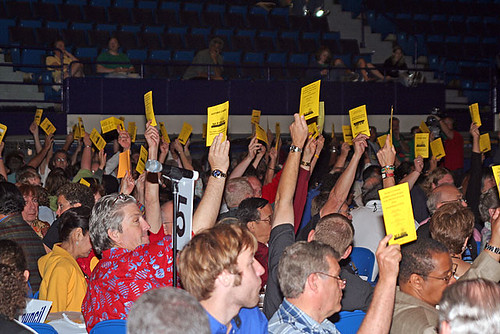
Today was a day busy with business at Synod. Much of today's time was spent taking action on resolutions. The first two resolutions addressed both concerned the resolution passed at General Synod two years ago in Atlanta supporting equal marriage rights for all. According to the standing rules for this gathering, resolutions of witness such as these require a 2/3 majority vote. So, even though it might appear that the Synod was weak-willed on these resolutions by voting “no action,” there are two important points to make. First of all, the votes were overwhelming (as they needed to be) and the reason given by the committee for taking “no action” in lieu of simply voting to defeat the resolutions was that this was one way of recognizing the divisive nature of this issue within our denomination. I must agree that since the committee (representing 10% of the delegates) reported that the opinion of the committee members was nearly unanimous in opposition, it would do little good to bring about a vote that might re-open wounds and end in no change of position. This is a good model of the church at work.
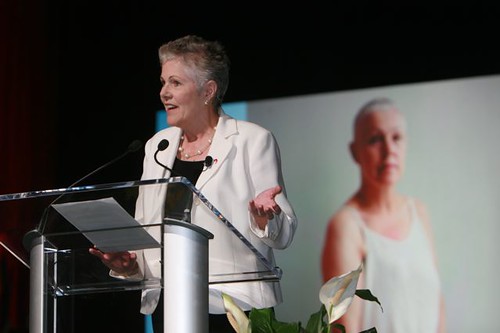
Another moving moment occurred when actress Lynn Redgrave shared the story of her struggle with breast cancer, accompanied by a powerful collection of photos taken by her daughter. At the heart of her tale was the fact that she had not been a regular church-goer, but after her mastectomy she heard that there was a female minister at a church in her town, so she went because she thought a woman might be more understanding. On her first Sunday there she heard words that were familiar and prayers for others who were likewise suffering and it put her suffering in perspective, and as she put it, she “lost her innocence.” It was stirring and assuring to hear someone speaking of finding care and comfort in the local church. This is where “the rubber hits the road” in church growth.
In the afternoon, a pastor of a church who three weeks ago took a vote considering leaving the UCC spoke to the body telling us that he encouraged his church to remain in the denomination because as he put it, “they need us for theological diversity.” He told us that a later speaker said, “sure, they need us but they don't want us.” He then assured us that his experience at General Synod has been one of extravagant welcome and thus supported the resolution on Reaffirming Our Commitment to Observing Covenant (or something like that...it was renamed from Reaffirming Our Faith to Retain Our Churches). It was nearly unanimously passed, certainly reaffirming our commitment to seek unity in diversity.
A resolution stating concern about the nation's immigration policies was passed after a small amount of debate. A resolution calling for a study of the issue of the legalization of physician aid in dying was passed on a split vote (2/3 was required) after some amendments and much debate. A resolution calling for solidarity with the persecuted in the Philippines, where disappearances and death squads are serious problems, was passed after a minor debate about language. The final resolution was in opposition to the use of depleted uranium in weapons and passed easily.
Typical of church business, a large amount of time was devoted to an issue involving a simple issue of the allocation of money. On a close vote, the body decided to allocate money from the Strengthen the Church offering to support the Still Speaking Initiative. The beauty of the process was shown in the fact that after the vote count was announced, the moderator's request that there be no applause was honored and a prayer was offered instead.
While there is a tad bit of business left that will push the beginning of evening worship back some, all that remains is closing worship in which we will be challenged and anointed to service.
This afternoon in the plenary session of the General Synod, a resolution calling on us as churches of the UCC to address global warming was nearly unanimously passed. An interesting (at least to this vegetarian) was an effort to insert a call to encourage a movement toward a plant-based diet since, according to the one making the suggestion, animal agricultural efforts contribute 18% of greenhouse gases world-wide. The amendment was out of order for parliamentary reasons, so the will of the body was never determined.
During her candidate's speech , Edith Guffey (Associate General Minister) mentioned something that struck a chord with me. She pointed out that most members of the UCC don't know who the denominational officers are. This came home to me yesterday when one church member asked about who the people were that we pray for during our communion prayers and another, who attended the worship at Synod yesterday, said, “So THAT is John Thomas.” So whether you've met them or not, our leaders are busy serving the church and I can assure you that they appreciate our prayers.
Marian Wright Edelman, director of the Children's Defense Fund, continued the practice of delivering exceptionally inspirational keynote addresses at General Synod. She delivered an impassioned plea to work to make sure that Congress provide health care coverage for 9 million uninsured children in America. She pointed out that Congress voted to go to war in Iraq without first coming up with the money to so, and isn't providing health care to children more important? She ended with a prayer that included “Dear God, let us not confuse what is perfectly legal with what is right and just in your eyes. Amen.”
Ken Medema, an extremely talented musician, was charged with responding in song. He improvised a beautiful song incorporating words from the person who introduced her, “sometimes you have to stand up when you just want to sit down.” So he sang to Marian that we would all stand up and not sit down until the job is done. While he was singing, one by one people in the audience stood up. By the end of the song we were all standing, many wiping tears away. Marian was among the tearful as she ran back onto the stage to embrace Ken in thanks.
Filled with the inspiration of that moment I left the building to join in a march around the block in protest of the war. As I turned one corner I encountered our Associate Conference Minister, Peter Wells, standing on a wall staring down the marchers. He shouted “what do you want for your children?” Indeed, we all want peace.
Busy days are in order because the United Church of Christ is celebrating its 50th birthday at its annual meeting in Hartford and I've been attending. Today was day 2 of 5.
Today's buzz was all about Senator Obama. Unfortunately, like Barack's own pastor, I had to miss his speech since I was elsewhere officiating a wedding. It was very lovely and through the wonders of the Internet I don't have to miss the speech...and neither do you. You can view it here or you can read the text here
The part of the day that I did attend that was incredibly inspiring was the address by Bill Moyers. In addition to his credentials as a first-rate journalist with impeccable integrity, he also has earned a Masters of Divinity and that showed in his talk this morning. He reminded us that Jesus saw the corruption in the temple and "threw the rascals out." He called on us to do the same with the corrupt leaders in our goverment for the sake of preserving democracy. You can read more about his talk by following the link in the UCC headlines section that has been newly added to our church web site at www.brimfieldfcc.org.
I also attended a stimulating talk about on-line social networking and the implications for the way our youth are learning to socialize. It is a little hard to unpack that in this email, but I am very interested in this topic and will try to involve our youth more in this area. One interesting development is that there is now a UCC church under construction in Second Life. If that means nothing to you, don't fret, but if you already know about Second Life, check out the island of Xenia and look for Sophianne Rhode.
Tonight the birthday party for the denomination included a tribute to the inventor of the laser, who is a member of a UCC congregation. He spoke to us about the compatibility and similarity of religion and science. We also got to see a flashy demonstration of his invention. Here is some video: I need to do a lot of digesting and review my notes to be able to post some responses. Tomorrow is a time for a huge worship service, I can't wait!