Saturday, February 25, 2012

Matt 8:23-27

Jesus was able to find rest in the storm. He slept while the sea raged. Sabbath rest is not just the absence of activity, it is also an action. When Genesis describes what God does after creating all that is, it could just as easily be translated as “God began sabbathing.”


On this Sabbath where are you finding rest in the storm?

Matt 5: 21-48

Lest the disciples misunderstand the significance of living by God’s commandments, Jesus extends them to broader and broader circumstances that turn the taboos of ancient culture on their heads. Jesus insists that not just murder, but insult, anger, and debts of all kinds have the power to separate us from God’s love. There is nowhere to hide! Jesus teaches the disciples that making amends and asking for forgiveness, even with our enemies, is what God is asking of us.

God, help us to open to your grace as we gently examine our hearts.

Friday, February 24, 2012

Matt 8:14-15

A story about healing a mother-in-law who then gets up and starts serving the healer sounds like the beginning of a joke, but it is story shared for our benefit by Matthew. Central to the story of our faith is the concept of being blessed in order to be a blessing. This story shows that in action. Gratitude for healing leads to service.


What have you received that now empowers you to serve gratefully?

Matt 5: 17-20

Jesus makes clear that his mission is not to abolish the teachings of the Hebrew bible, the five books of Moses and the prophetic teachings, but to fulfill them and to help others to fulfill them so that they might enter the kingdom of heaven. This was an age, just like ours, in which people anticipated the end of the known world. Practicing love and forgiveness, feeding the hungry and protecting the weak were radical acts of faith in God’s goodness, acts that not only anticipated the kingdom of heaven, but also worked to manifest the kingdom on the earth.


God, may we be open to encountering the kindness and mercy of others today. May it shine like a beacon of hope into our lives.

Thursday, February 23, 2012

Matt 8:5-13

This story is a reminder that the power of God is never limited by our understanding of it. Jesus doesn't have to appear in the flesh for healing to happen. That is good news for us living 2000 years after Jesus lived. But this is also a reminder that works require faith. What is the point of asking for an action if you don't believe that the action will happen? Healing came for the servant because someone else believed and acted.


What are you not receiving because you have not asked because you don't truly believe it will happen?

Matt 5:13-15

Salt and light were essentials of life in the ancient world. True salt was so important; it was often used as currency. Salt was a matter of life or death, the only way to preserve food in the intense heat. And the oil in the temple that fueled the ever-burning flame was a sign of the assurance of God’s love and protection. When Jesus tells the disciples that they are salt and light, he is reflecting back to them their true value as children of God.


God, help us to recognize our value to each other as we bravely and humbly shine our light wherever we are today.

Wednesday, February 22, 2012

Matt 8:1-4

Jesus is moved to action through mercy. This and other healing stories show Jesus' concern not to draw attention to himself or even his ministry. In this case he compassionately responds to a plea from someone who is an outcast because of his illness. The man with a skin disease is unable to participate fully in society. He is not permitted to worship at the temple and fear of contagion keeps others away from him. While these details don't pertain to our situation today, we surely have too many people separated from full participation in society because of stigmas of all sorts. As followers of Jesus we need to show mercy and remove those stigmas so that all may fully participate in society. Surely we have the power since we are the ones who created them.


What stigmas can you help to remove by simply refusing to continue to support them?

Matt 5:1-12

As we enter this season of Lent, we already know how the story ends. It’s the story of the fulfillment of a promise embedded in Hebrew scripture, God’s promise to Israel to send a Messiah, a new king, who would raise up the righteous and usher in the promise of the kingdom of heaven. In this passage we hear echoes of Moses encountering God on the mountaintop as he received the Ten Commandments. The disciples follow Jesus up the mountain where he begins to share with them the promise of God’s blessing on all who hunger after righteousness, all that are pure of heart…peacemakers and prophets.

As we travel to Easter morning, we have the opportunity to examine our hearts as we follow in the footsteps of Jesus. Where will we encounter God on this journey through suffering, death, and resurrection? How are we blessed, filled, and comforted by God’s grace in our daily lives?


God help us to hear your voice calling each of us to do our part in ushering in the kingdom of heaven on earth.

Tuesday, February 21, 2012

Daily meditations can be a beneficial Lenten practice. It is our hope that by focusing on one gospel you will take these forty days to gain a perspective on the life and ministry as presented by Matthew. We recommend that before you begin the daily readings that you take the time to read the entire gospel, preferably in one sitting.


The Gospel of Matthew is structured around groupings of the teachings of Jesus, called the five great discourses. These daily meditations are structured around those discourses. Each day you will find two meditations, each will be posted on the blog, where you may feel free to respond with a comment. The first is written by Mardi on some piece of a teaching story and will be posted at midnight. The second is written by Ian on some story about the actions of Jesus or the disciples that comes from the section following that discourse and will be posted at noon. During Holy Week the focus shifts to scriptural stories about storms. Those six stories will shape the Sunday worship services during Lent.


Feel free to use these meditations as best suit you. You could read them both at the same time. You can use one to begin your day and the other to reflect on it. You could use Mardi's prayer as a repeated grounding throughout the day or you could use Ian's question as a pondering throughout your day. However you use them we hope that they bless you and that you will consider sharing what you discover on this 40-day journey with others along the way.


Peace and blessings,


Ian and Mardi

Tuesday, March 18, 2008

Celebrating What's Right with the World

Former National Geographic photographer, Dewitt Jones, says that his assignments for the magazine always entailed seeing what's right with the world. On assignments to areas where there was suffering he always looked for what was right even in terrible suffering. That perspective helped him to take award-winning photographs showing beauty in many situations. This is not just a shallow attempt to ignore pain, although it certainly can be limited to pretending that all is well when it is not. What I hear in his message is the importance of perspective. Sometimes it is easy to see blessing, sometimes we have to believe that God's blessing is present and dig deeper to find it.

In the Sermon on the Mount, Jesus insists that the most unlikely ones are the ones who are blessed. He tells us that the poor, the humble, and those who mourn are blessed. He even tells us to rejoice when we are persecuted! The word that is translated “blessed” (or sometimes “happy”) might better be translated “privileged by divine favor.” Consider that aspect of blessing; when you suffer, you are privileged because God will be with you in that suffering.

As we move toward the dark specter of holy week, when we remember Jesus' suffering and death, it is good to consider how his willingness to accept his fate brought redemption to the horror of the cross. God is present in the world in the work of the crucifixion. In the extreme ugliness of human behavior God brings the good news that death is not the ultimate
victor.

Because of Easter, we can be unashamed hope-mongers. There is no evil so great that God cannot defeat. And when we embrace this truth and make it our own, we can be our best for the world. The good news of Easter is not just about your individual trip to heaven. It is about the hope that there is always something right with the world, regardless of appearances to the contrary. When we are our best for the world, we have something extremely positive to share, the gospel. We have the joy of sharing the good news with others. But there is no good news to share if you don't see what's right in your life and in the world around you. There is no point in walking somewhere to preach if your walking isn't preaching!

So live the good news that death has no sting and the grave is not the victor!

Wednesday, October 03, 2007

Diversity

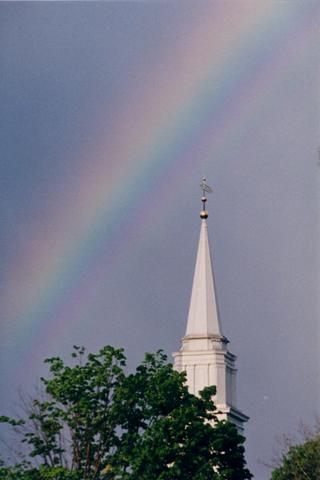
When I was ministering in Salem, I learned a valuable lesson about true diversity. Our inter-faith religious leaders group had the challenge of being truly inter-faith. It wasn't the typical group of Christian clergy making room for the rabbi. The faith communities in Salem included Fundamentalist house churches, B'haiis, and pagans of many stripes. When we gathered in community worship we found that we couldn't just reduce everything down to that which wouldn't offend. It was alright when the Christians met with Jews, we could agree to stick with the Old Testament, but start throwing in groups that don't recognize that as scripture and you start to find less to share. This least common denominator approach proved quickly to be ineffective, since it left us with nothing to use. Instead we decided to welcome each participant to bring something from the richness of his or her tradition. This developed into a new tradition for us. At the end of each joint worship service, every participating religious leader offered a benediction. The rainbow blessing of multiple faiths was rich and deep.

I have brought that mentality into my pastoral ministry among you. I realized early on that there wasn't and wouldn't be unanimity of beliefs here. One option might have been to try to change those who differed with me, possibly even working to eradicate the opposition. While I certainly am tempted at times to move in that direction, I always quickly snuff out this sinful tendency. Neither can it become a numbers game. In this respect, absolute democracy cannot be our model. It is too easy to marginalize and even oppress any minority, but particularly small ones. Our community needs the richness and depth provided by every member and thus must be respectful of every opinion. This is by no means easy to do. We must agree to disagree, without becoming disagreeable. That requires of us two critical behaviors. First, you must be willing to speak up when you are in the minority, even if that becomes a minority of one! Second, you must be willing to listen to the opinions of those who disagree with you. If we can keep our speaking and listening in balance and full of respect, we will know the richness of diversity.