Bloggings of the pastor of First Congregational Church, Brimfield, Massachusetts.
You are a vessel designed to hold God's blessings. God wants to fill you to the brim...and then some!
Former National Geographic photographer, Dewitt Jones, says that his assignments for the magazine always entailed seeing what's right with the world. On assignments to areas where there was suffering he always looked for what was right even in terrible suffering. That perspective helped him to take award-winning photographs showing beauty in many situations. This is not just a shallow attempt to ignore pain, although it certainly can be limited to pretending that all is well when it is not. What I hear in his message is the importance of perspective. Sometimes it is easy to see blessing, sometimes we have to believe that God's blessing is present and dig deeper to find it.
In the Sermon on the Mount, Jesus insists that the most unlikely ones are the ones who are blessed. He tells us that the poor, the humble, and those who mourn are blessed. He even tells us to rejoice when we are persecuted! The word that is translated “blessed” (or sometimes “happy”) might better be translated “privileged by divine favor.” Consider that aspect of blessing; when you suffer, you are privileged because God will be with you in that suffering.
As we move toward the dark specter of holy week, when we remember Jesus' suffering and death, it is good to consider how his willingness to accept his fate brought redemption to the horror of the cross. God is present in the world in the work of the crucifixion. In the extreme ugliness of human behavior God brings the good news that death is not the ultimate victor.
Because of Easter, we can be unashamed hope-mongers. There is no evil so great that God cannot defeat. And when we embrace this truth and make it our own, we can be our best for the world. The good news of Easter is not just about your individual trip to heaven. It is about the hope that there is always something right with the world, regardless of appearances to the contrary. When we are our best for the world, we have something extremely positive to share, the gospel. We have the joy of sharing the good news with others. But there is no good news to share if you don't see what's right in your life and in the world around you. There is no point in walking somewhere to preach if your walking isn't preaching!
So live the good news that death has no sting and the grave is not the victor!
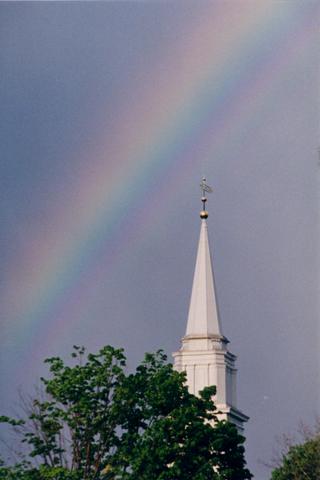
When I was ministering in Salem, I learned a valuable lesson about true diversity. Our inter-faith religious leaders group had the challenge of being truly inter-faith. It wasn't the typical group of Christian clergy making room for the rabbi. The faith communities in Salem included Fundamentalist house churches, B'haiis, and pagans of many stripes. When we gathered in community worship we found that we couldn't just reduce everything down to that which wouldn't offend. It was alright when the Christians met with Jews, we could agree to stick with the Old Testament, but start throwing in groups that don't recognize that as scripture and you start to find less to share. This least common denominator approach proved quickly to be ineffective, since it left us with nothing to use. Instead we decided to welcome each participant to bring something from the richness of his or her tradition. This developed into a new tradition for us. At the end of each joint worship service, every participating religious leader offered a benediction. The rainbow blessing of multiple faiths was rich and deep.
I have brought that mentality into my pastoral ministry among you. I realized early on that there wasn't and wouldn't be unanimity of beliefs here. One option might have been to try to change those who differed with me, possibly even working to eradicate the opposition. While I certainly am tempted at times to move in that direction, I always quickly snuff out this sinful tendency. Neither can it become a numbers game. In this respect, absolute democracy cannot be our model. It is too easy to marginalize and even oppress any minority, but particularly small ones. Our community needs the richness and depth provided by every member and thus must be respectful of every opinion. This is by no means easy to do. We must agree to disagree, without becoming disagreeable. That requires of us two critical behaviors. First, you must be willing to speak up when you are in the minority, even if that becomes a minority of one! Second, you must be willing to listen to the opinions of those who disagree with you. If we can keep our speaking and listening in balance and full of respect, we will know the richness of diversity.
The Collegium of Officers of the United Church of Christ have written a powerful pastoral letter against the war in Iraq and are asking others to sign the letter. Their goal is 100,000 signatures by World Communion Sunday, October 7. They call us to seek forgiveness for "the arrogant unilateralism of preemptive war." They also call us to "cast off the fear that has made us accept the way of violence and return to the way of Jesus."
The ideal of returning to the way of Jesus coupled with the letter's opening paragraph decrying the way this war was justified serve as a reminder that the acceptance of war as a necessary evil was not always a part of Christian thinking. For the first three centuries of Christianity, pacifism was the primary view of Christians. Early church leaders such as Origen and Tertullian wrote tracts on the subject. Roman soldiers who converted to Christianity were instructed not to kill! All of that changed rapidly when the emperor Constantine made Christianity the official state religion. By his edict, Christians went from being social pariahs who could be killed for their beliefs to being the only ones who could be soldiers or political leaders. Needless to say, this had a radical impact on Christian teaching. Augustine created a compromise position, which has come to be knows as the Just War Theory, stipulating principles that had to be met in order for a war to be considered just. Just War Theory is clear that no war can be started preemptively as an act of aggression, that it cannot be used for acquisition of land, power or resources, and that civilians may never be targeted. Applied to the current war, all of these principles raise serious questions. In fact, the sickening ratio of civilian to military causalities in every battle fought today begs the question of whether modern warfare can ever be considered just.
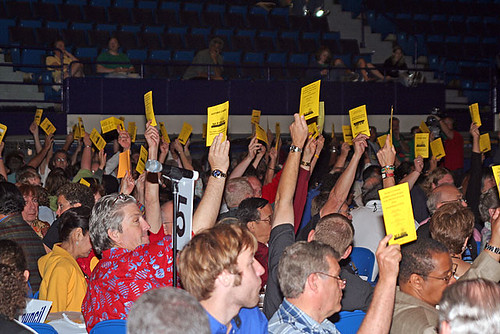
One of the oddities of our polity in the United Church of Christ is that our leaders are not empowered to speak for us, instead they may speak to us. Our church government is not a republic or a representative democracy. We elect our leaders to serve us, not represent us. This is also true when delegates gather at the various settings of our church: Association, Conference and General Synod. Some have argued that since these bodies cannot speak for us that they should not make statements of witness. A primary reason why we haven't gone that route is that we perceive a need to listen for the still-speaking God's prophetic call to the churches. So, when General Synod gathered in Hartford this past week, a number of resolutions called the churches out to social action and witness in the world. Some of us won't agree to do what we are asked to do by this body of delegates. That should come as no surprise since to the best of my knowledge all of the votes included votes in opposition, thus not even all of those speaking to us agree with each other.
And that is another odd strength of our denomination; our attempt to seek unity without simultaneously embracing diversity. There is a great story by an Episcopal priest named Martin Bell called Rag-Tag Army. In it, Bell describes an army on the march, led by God. This army contains some who are barefoot, some off wandering in the brambles and some playing with frogs. The drumbeat isn't regular and no one is in step. But God keeps stopping to make sure that no one gets lost. Some in this army hold hands but that leaves those on the end of the line without a hand to hold, so they join hands and make a circle. A large circle is deceptive because it appears that the marchers are going somewhere other than round and round. Still, God won't stop. The march goes on.
I love that story for the image of the variety of us Christians stumbling along, no matter who we are or where we are on life's journey. God refuses to move the march along if even one would be left behind. For that truth we can shout “ALL-eluia!”
I also have long loved that story for the simple truth it tells about human nature. We are indeed God's rag-tag little army, doing our best to stay on task following God. So sometimes we have to resist the temptation to take charge, but only speak to one another what we think we have heard are the orders of the one leading the march. Even when we hear more of ourselves or our fellow marchers and not enough of the true leader, we can still at least rejoice that God is still speaking...and still leading!
Today was a day busy with business at Synod. Much of today's time was spent taking action on resolutions. The first two resolutions addressed both concerned the resolution passed at General Synod two years ago in Atlanta supporting equal marriage rights for all. According to the standing rules for this gathering, resolutions of witness such as these require a 2/3 majority vote. So, even though it might appear that the Synod was weak-willed on these resolutions by voting “no action,” there are two important points to make. First of all, the votes were overwhelming (as they needed to be) and the reason given by the committee for taking “no action” in lieu of simply voting to defeat the resolutions was that this was one way of recognizing the divisive nature of this issue within our denomination. I must agree that since the committee (representing 10% of the delegates) reported that the opinion of the committee members was nearly unanimous in opposition, it would do little good to bring about a vote that might re-open wounds and end in no change of position. This is a good model of the church at work.
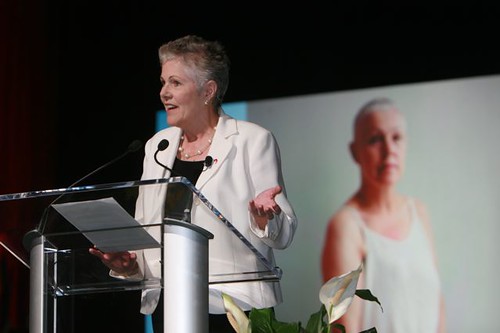
Another moving moment occurred when actress Lynn Redgrave shared the story of her struggle with breast cancer, accompanied by a powerful collection of photos taken by her daughter. At the heart of her tale was the fact that she had not been a regular church-goer, but after her mastectomy she heard that there was a female minister at a church in her town, so she went because she thought a woman might be more understanding. On her first Sunday there she heard words that were familiar and prayers for others who were likewise suffering and it put her suffering in perspective, and as she put it, she “lost her innocence.” It was stirring and assuring to hear someone speaking of finding care and comfort in the local church. This is where “the rubber hits the road” in church growth.
In the afternoon, a pastor of a church who three weeks ago took a vote considering leaving the UCC spoke to the body telling us that he encouraged his church to remain in the denomination because as he put it, “they need us for theological diversity.” He told us that a later speaker said, “sure, they need us but they don't want us.” He then assured us that his experience at General Synod has been one of extravagant welcome and thus supported the resolution on Reaffirming Our Commitment to Observing Covenant (or something like that...it was renamed from Reaffirming Our Faith to Retain Our Churches). It was nearly unanimously passed, certainly reaffirming our commitment to seek unity in diversity.
A resolution stating concern about the nation's immigration policies was passed after a small amount of debate. A resolution calling for a study of the issue of the legalization of physician aid in dying was passed on a split vote (2/3 was required) after some amendments and much debate. A resolution calling for solidarity with the persecuted in the Philippines, where disappearances and death squads are serious problems, was passed after a minor debate about language. The final resolution was in opposition to the use of depleted uranium in weapons and passed easily.
Typical of church business, a large amount of time was devoted to an issue involving a simple issue of the allocation of money. On a close vote, the body decided to allocate money from the Strengthen the Church offering to support the Still Speaking Initiative. The beauty of the process was shown in the fact that after the vote count was announced, the moderator's request that there be no applause was honored and a prayer was offered instead.
While there is a tad bit of business left that will push the beginning of evening worship back some, all that remains is closing worship in which we will be challenged and anointed to service.
This afternoon in the plenary session of the General Synod, a resolution calling on us as churches of the UCC to address global warming was nearly unanimously passed. An interesting (at least to this vegetarian) was an effort to insert a call to encourage a movement toward a plant-based diet since, according to the one making the suggestion, animal agricultural efforts contribute 18% of greenhouse gases world-wide. The amendment was out of order for parliamentary reasons, so the will of the body was never determined.
During her candidate's speech , Edith Guffey (Associate General Minister) mentioned something that struck a chord with me. She pointed out that most members of the UCC don't know who the denominational officers are. This came home to me yesterday when one church member asked about who the people were that we pray for during our communion prayers and another, who attended the worship at Synod yesterday, said, “So THAT is John Thomas.” So whether you've met them or not, our leaders are busy serving the church and I can assure you that they appreciate our prayers.
Marian Wright Edelman, director of the Children's Defense Fund, continued the practice of delivering exceptionally inspirational keynote addresses at General Synod. She delivered an impassioned plea to work to make sure that Congress provide health care coverage for 9 million uninsured children in America. She pointed out that Congress voted to go to war in Iraq without first coming up with the money to so, and isn't providing health care to children more important? She ended with a prayer that included “Dear God, let us not confuse what is perfectly legal with what is right and just in your eyes. Amen.”
Ken Medema, an extremely talented musician, was charged with responding in song. He improvised a beautiful song incorporating words from the person who introduced her, “sometimes you have to stand up when you just want to sit down.” So he sang to Marian that we would all stand up and not sit down until the job is done. While he was singing, one by one people in the audience stood up. By the end of the song we were all standing, many wiping tears away. Marian was among the tearful as she ran back onto the stage to embrace Ken in thanks.
Filled with the inspiration of that moment I left the building to join in a march around the block in protest of the war. As I turned one corner I encountered our Associate Conference Minister, Peter Wells, standing on a wall staring down the marchers. He shouted “what do you want for your children?” Indeed, we all want peace.
Busy days are in order because the United Church of Christ is celebrating its 50th birthday at its annual meeting in Hartford and I've been attending. Today was day 2 of 5.
Today's buzz was all about Senator Obama. Unfortunately, like Barack's own pastor, I had to miss his speech since I was elsewhere officiating a wedding. It was very lovely and through the wonders of the Internet I don't have to miss the speech...and neither do you. You can view it here or you can read the text here
The part of the day that I did attend that was incredibly inspiring was the address by Bill Moyers. In addition to his credentials as a first-rate journalist with impeccable integrity, he also has earned a Masters of Divinity and that showed in his talk this morning. He reminded us that Jesus saw the corruption in the temple and "threw the rascals out." He called on us to do the same with the corrupt leaders in our goverment for the sake of preserving democracy. You can read more about his talk by following the link in the UCC headlines section that has been newly added to our church web site at www.brimfieldfcc.org.
I also attended a stimulating talk about on-line social networking and the implications for the way our youth are learning to socialize. It is a little hard to unpack that in this email, but I am very interested in this topic and will try to involve our youth more in this area. One interesting development is that there is now a UCC church under construction in Second Life. If that means nothing to you, don't fret, but if you already know about Second Life, check out the island of Xenia and look for Sophianne Rhode.
Tonight the birthday party for the denomination included a tribute to the inventor of the laser, who is a member of a UCC congregation. He spoke to us about the compatibility and similarity of religion and science. We also got to see a flashy demonstration of his invention. Here is some video: I need to do a lot of digesting and review my notes to be able to post some responses. Tomorrow is a time for a huge worship service, I can't wait!
At the World Series of Birding, there is a longstanding tradition of “breaking bread with the enemy.”This takes the formal form of a “swap meet” on the Thursday night before the competition.The informal breaking of bread with the enemy is a continual process that begins as soon as two birders who are scouting for their respective teams meet in the field.It also takes the form of shared trips into the field, and this year it even included a web site updated daily by one of the top-flight teams.Our team, the Wicked Witchities, was able to add a number of nests and one particularly active feeder because we were in regular contact with other teams’ scouts.In fact, on most days of the week preceding the competition, at least one of my teammates was scouting with one or more scouts from another team.One day I met up with another team’s scout in the field who had been speaking to one of my teammates more recently than I had!All of this is the case because we all believe that a rising tide raises all boats.In other words, one way to help one team do well is by helping all the teams do better.Even though this is a competitive event, there is more emphasis on the birds than the birders.Of course I want my team to do better than other teams, but while we are witchities and they are luna-ticks or lagerheads, we are all lovers of birds and trying to help preserve them and the environment that sustains them.
Unfortunately, this sort of mutual aid and cooperation is all too rare in our dog-eat-dog world today.Even more sad is the way in which the divisive and demeaning practices rampant in our culture work their way into the practices of our churches.I’m particularly sorry that our local congregations remain islands of independent effort.There is a wealth of talent eager to be used in God’s service residing in the pews of all the church buildings around us as well as our own.We have all found ourselves from time to time bemoaning the fact that we don’t have enough people or other resource to accomplish some worthy goal.Perhaps if we paused every time we spoke like this and simply imagined the same conversation happening in another congregation we would begin to understand the truth that “there is no they….just more of us!”Some of us here and some more of us there could get together and get more done.I really don’t understand why there isn’t more desire for this sort of solution.Perhaps part of it lies in diminished expectations based on history.The expected way of connecting with other churches would first be through our denomination.Particularly in the United Church of Christ, we only have connection if we make it happen since there is no hierarchy to impose it.Since there seems to be a natural tendency to grant authority to those willing to represent us at wider settings, we have at times gotten ourselves into the spot of looking to “them” (i.e. the staff in Framingham or in Cleveland) to do things for “us.”But (and don’t tell me you didn’t see this coming) there is no they!There is no “they” who will come and fix our problems, there is no “they” who are the cause of our problems, there is no “they” who are the ones we need to oppose…or support.The truth about the church is that we are the body of Christ and therefore we are one.We are the ones who are both solution and source of all our problems, we are the one body, which includes diverse and opposing views and positions.With Christ as our head we don’t lack for direction. With the Holy Spirit as the breath filling the lungs of this body with life, we lack for nothing.We are strong enough to change the world, but only as we recognize our unity.If a bunch of crazed birders can find a way to work together for the common good in the course of a heated competition, then perhaps there is hope for the church of God gathering together in both large and small ways to bring the life-giving gospel to the places of hurt in the world.
One of the happiest sentences I heard uttered by a parishioner recently was “I’m tired of not doin’ nothin’.”She was suggesting a idea to do some recycling—simple enough, but significant because it mattered that it meant making a difference.Isn’t that really what we are called on to do; make a difference?During Lent we spent time reflecting on our call to be difference-makers.We dedicated fasts that included
walking instead of driving for short trips
drying laundry on the line instead ofin the dryer
washing clothes in cold water
purchasing carbon offsets
giving up butter, drinking skim milk
replacing light bulbs with fluorescents
using the microwave less
give up bottled water
collecting empty juice and water bottles for recycling
spend more time as a steward of woodlands
give up processed foods & goods from China
give up the gas stove and electric lights
I can’t report on whether everyone was faithful in their fasts, but I do know some things.I know that Judy cleaned out multiple huge bags of plastic recyclables from the teachers’ lounges where she works.I know that Pat and Kate didn’t use their stove or lights for the full six weeks.And I know that my family didn’t buy the more than half-dozen cases of bottled water that we would have.
If I had to guess, I’d say that the impact we had collectively on reducing greenhouse gases was well over a hundred pounds (not to mention the two tons of offsets that were purchased).And to top it off, we planted a tree on Earth Day!We can celebrate the fact that we are indeed difference-makers.We are hearing and responding to the challenge of Dr. Suess’ Lorax, “unless someone like you cares a whole awful lot, nothing is going to get better, it’s not.”
Personally, I’m still walking to the church when I can and with the warm weather a clothesline has gone up in the back yard.The great lesson from disciplines like Lenten fasts is that they can bring joy and become easier to maintain.As we all strive to make a difference with the lives we are given, we will find the power of what one person can do. As the African proverb says, "If you think you're too small to make a difference, try going to bed with a mosquito in the room.” And a people of God gathered in a community of faith practice, we also can see the power of working as one.Brothers and sisters, it is in seeing the power of difference-making that we can see the truth of our salvation!
There is a song by U2 that includes a litany of things that the singer regrets doing, but they were all before “love came to town.” There is no doubt that when love comes to town things change radically. We see that in our lives and the lives of those around us when a couple falls in love. It is like everything is seen through a new pair of glasses.
A wise caution I have received from my Tai Chi instructor is that Tai Chi will first be a struggle, then you will love it, and then it will ruin your life! The reason that love of the practice will ruin your life is that eventually you won’t be able to find enough time to do it, not because you are avoiding doing it like at the beginning, but because you won’t want to stop doing it to do the other things in your life.
This is how love both triumphs and conquers. Love never fails. Love cannot be killed. Love is a light that is never extinguished. Love makes all things new. In love there is a new creation.
Love is the Easter story in a single word. God’s love is seen most evident in the historical moment of the first Easter morning and is felt most closely when we allow the love of Resurrection to “ruin” our lives. When the truth of God’s love for you seen in the triumph of life over death on Easter morning (not just then, but now) really grabs hold of you, nothing can ever be the same again.
The disciplines of Lent have their payoff in this moment of truth. What good has been produced in your life by walking the journey through the shadows to the light of Easter? How has that changed you so that your life is now “ruined” because you cannot not continue on the path that brought you here?
Love has come to town and now all the good that God chooses to do through you is possible…as long as you continue to be willing to walk in the light no matter how much that “ruins” the life you had before. May you know the refreshing presence of Christ who has arisen, for as you live your life for God you prove that Christ has risen indeed!
Simply put, if we are going to save the planet, the emphasis needs to be on the “we.” I’m not suggesting that the work each of us does individually doesn’t matter (though the impact is obviously seen collectively). But I am saying that we individual humans function a whole lot better when we act as one. Finding that unity may sound like one of the more difficult challenges that lays ahead, but I want to tell you that my experience Monday taught me otherwise.
For 16 miles from Ware to Spencer, I joined with the wonderful, faith-filled, strong-legged and beautiful-footed people who have chosen to take the Interfaith Walk for Climate Rescue. Close to 40 people shared that day’s pilgrimage and more than a dozen of them started in Northampton with the goal of going all the way to Boston. Bound together in a common purpose, we individual seekers sought out each other to learn from our diversity and exult in our unity.
There was Margaret, a likely candidate for companionship since we are both ordained. When I learned that she was Episcopalian I showed her the Anglican prayer beads that have been in my pocket every day during Lent. She responded by whipping out her own and was eager to learn how I have been using them to pray the prayer of Saint Francis. “What comes after ‘where there is darkness, light’?” she asked a number of steps closer to Spencer. “Where there is sadness, joy,” I said. Two Protestant clergy praying a Catholic prayer seems to be one simple way to becoming instruments of God’s peace.
There was Steve, culturally Jewish, but an atheist—or so said Newall as they introduced themselves to me the night before as they welcomed me into “the men’s caucus.” But gender wasn’t all that I had in common with Steve. Aside from a shared love of a laugh and my own proclivity to channel my “inner rabbi,” Steve said that he is in awe of the way that us religious folks find the motivation to do these acts of hopeful witness. Well hello Steve, you have obviously found some well to tap as well since you are taking your tired legs and aching feet all the way to Boston this week! When we get right down to it, we all have more in common than the interesting, but few things that separate us.
There was Kate, who blessed me with the most darling welcome with a hand on my cheek and a smile in her deep eyes assuring me that I would be sheltered and fed and embraced by the group. Of course she was correct. This was the sort of crowd where I knew that my vegetarian ways would be no obstacle and I indeed was fed—delicious food and nourishment that my soul devoured.
There was Wren, a species unique in all the universe. I knew better than to insult her by asking if she was four. The wisdom of my reservation was revealed when she announced to me that she was four-and-three-quarters (oh how I adore children of this age, even when they declare themselves to be "super-bear" and address me as "dinner")! During the very first steps of the day I let her know that I would be searching for other wrens today as I wanted to record all the birds we encountered on our walk. I even played the song of the Carolina Wren for her, explaining that it sounds like it is saying “teakettle, teakettle, teakettle.” 29 species and over 35,000 steps later, she was the only wren I had seen or heard. Just before dinner I probably should have changed the list total to 30 when I heard her say, “I’m a Carolina Wren…teakettle, teakettle, teakettle.” Did I mention how much I adore children who are four-and-three-quarters, especially those who at such a tender age are compelled into walking (or riding in a stroller as was more often the case) across an entire state by parents who love them enough to work to improve what is left to them?
And there were many more encounters, all equally inspirational and heartwarming during that next to last winter’s day. Each of them worked their seductive spell on me, convincing me that there is yet hope for this sorry world. Each new encounter drew me in and made my departure that much more bittersweet. If only virtually or spiritually I will return to this rag-tag band of believers. But I have a feeling that my blistered feet will pound the pavement next to theirs before the week is over because God’s grip is awfully tight at times…especially in times like these when justice is so greatly required.